WorldView Stereopair Selection: SpaceNet Atlanta Example#
This notebook documents the stereo-pair selection analysis used to choose candidate pairs from the SpaceNet Off-Nadir Building Detection Challenge dataset over Atlanta, Georgia.
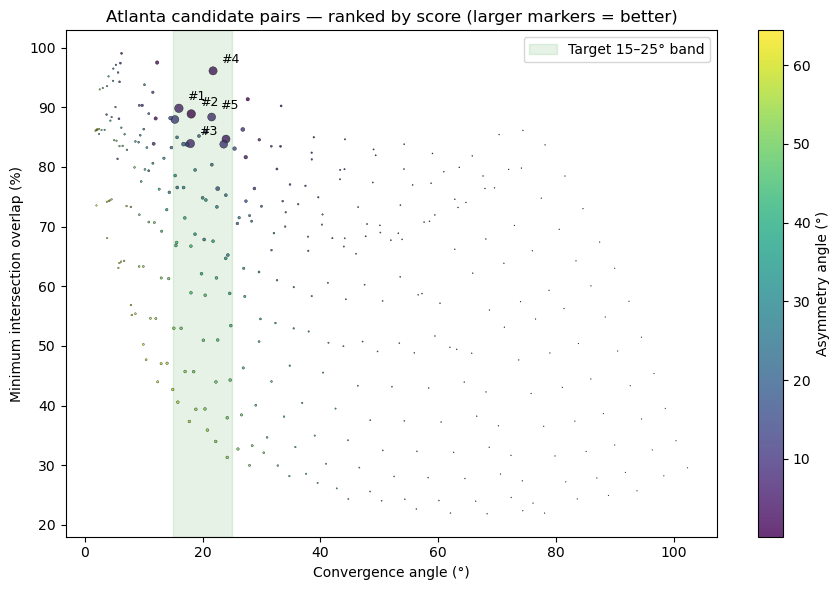
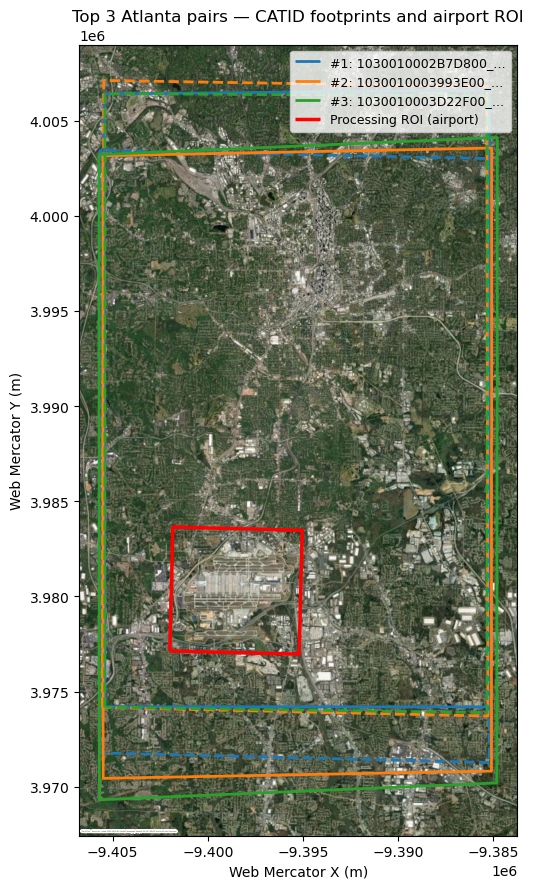
The goal is to scan the 27 usable WV2 CATIDs hosted under s3://spacenet-dataset/AOIs/AOI_6_Atlanta/metadata/, compute pair geometry with asp_plot.stereopair_metadata_parser, and select pairs with stable imaging geometry for the urban-dominated Atlanta airport processing ROI.
Background: stable imaging geometry#
Jeong, J. & Kim, T. (2016), Comparison of positioning accuracy of a rigorous sensor model and two rational function models for weak stereo geometry, ISPRS Journal of Photogrammetry and Remote Sensing 82(8): 625–633 — https://www.sciencedirect.com/science/article/abs/pii/S0099111216301021:
Stable imaging geometry, in addition to a precise sensor model, is also necessary to achieve detailed mapping. The stability of the imaging geometry can be expressed by the values of three angles: the convergence, bisector elevation (BIE), and asymmetry angles. The convergence angle reflects the base-to-height ratio; the BIE angle describes the obliqueness of the epipolar plane; the asymmetry angle specifies the level of symmetry between the left and right observation rays. In the ideal imaging geometry, the epipolar plane would be orthogonal (90° BIE angle) and symmetric (0° asymmetry angle) to the ground plane, to avoid accuracy degradation.
So the ideal is BIE → 90° and asymmetry → 0°. In this notebook these two angles are treated as secondary tiebreakers: they only move a pair up or down the ranking when they are notably far from ideal (BIE ≲ 70°, asymm ≳ 12°).
Convergence target for this scene#
Purely urban stereo analyses cite ~5–15° as the ideal convergence range — see Aguilar, M.Á. et al. (2019), 3D modelling of urban structures from very high resolution satellite imagery: a comparative analysis of convergence angle effect, European Journal of Remote Sensing, 52(sup1): 1–13 — https://www.tandfonline.com/doi/full/10.1080/22797254.2018.1551069#abstract. Small convergence reduces occlusion and matching failures on tall, steep-sided building facades.
The Atlanta processing ROI is centered on Hartsfield-Jackson Atlanta International Airport — a mix of flat runway and terminal infrastructure with some residential and wooded areas nearby. As with UCSD, we target ~15–25° convergence to balance occlusion concerns on built-up structures against height precision over flatter terrain:
Urban-only scenes: ~5–15° is ideal (minimizes building occlusion).
Natural / low-slope terrain: higher convergence (≳ 25°) is beneficial — the larger base-to-height ratio improves vertical precision where occlusion is not the limiting factor.
Mixed urban + natural scenes (Atlanta, UCSD): ~15–25° is a practical middle ground.
Single-pass MVS dataset#
All 27 Atlanta WV2 CATIDs were acquired on the same orbit pass (2009-12-22, within ~3 minutes of each other). This means temporal separation, solar elevation delta, and solar azimuth delta are effectively zero for every pair. The scoring therefore drops these terms entirely and focuses on:
Priority |
Criterion |
Direction |
|---|---|---|
Primary |
Convergence angle |
Target 15–25° |
Primary |
ROI overlap (containment of the Atlanta airport ROI) |
Full containment required |
Primary |
Off-nadir angle per scene |
Smaller (finer GSD, less oblique) |
Primary |
Sensor consistency |
WV2 + WV2 (all Atlanta scenes are WV2) |
Secondary |
BIE angle |
Tiebreaker; penalize only if ≲ 70° |
Secondary |
Asymmetry angle |
Tiebreaker; penalize only if ≳ 12° |
Atlanta-specific data layout notes#
Each CATID’s imagery is tiled into multiple P1BS images (P001, P002, P003, sometimes up to P005). The raw L1B NTFs and tile XMLs live under metadata/<CATID>/<workorder>_<PNNN>_PAN/. For scene selection we only need the XML camera models (satellite/sun angles, footprint polygon), which are very small (~1 MB each). This notebook downloads all tile XMLs for every CATID.
For each CATID the acquisition geometry (sat az/el, sun az/el, GSD) is identical across tiles — they all come from the same satellite pass. The footprint, however, differs per tile. We therefore:
use the first tile’s XML for the per-scene geometry values,
union all tile polygons to get the full CATID footprint for overlap analysis.
Setup#
This notebook only downloads the tile XMLs (very small). It does not download the ~2 GB NTF imagery for any CATID.
import os
import shutil
import subprocess
import tempfile
from itertools import combinations
from pathlib import Path

import contextily as ctx
import geopandas as gpd
import matplotlib.pyplot as plt
import numpy as np
import pandas as pd
from shapely import union_all
from shapely.geometry import box

from asp_plot.stereopair_metadata_parser import StereopairMetadataParser
from asp_plot.utils import get_xml_tag

WORK_DIR = Path("/tmp/atlanta_scene_selection")
XML_DIR = WORK_DIR / "xmls"
FLAT_DIR = WORK_DIR / "flat_xmls"
for d in (WORK_DIR, XML_DIR, FLAT_DIR):
    d.mkdir(parents=True, exist_ok=True)

S3_PREFIX = "s3://spacenet-dataset/AOIs/AOI_6_Atlanta/metadata/"

# Atlanta airport ROI — UTM Zone 16N (EPSG:32616), xmin ymin xmax ymax
# (from worldview_spacenet_atlanta_stereo.ipynb: ~5.7 x 5.4 km over Hartsfield-Jackson)
T_PROJWIN = (735685, 3722295, 741350, 3727695)
UTM_EPSG = 32616
1. Discover CATIDs and download tile XMLs#
We look for metadata/<CATID>/ entries (plain catid form, not the duplicated Atlanta_nadirXX_catid_<CATID>/ form — those only hold manifest files). For each CATID we aws s3 cp only the .XML files under its *_PAN/ subdirectories.
# List the plain-CATID subdirectories under metadata/
result = subprocess.run(
    ["aws", "s3", "ls", "--no-sign-request", S3_PREFIX],
    capture_output=True, text=True, check=True,
)
catids = []
for line in result.stdout.strip().splitlines():
    parts = line.split()
    if len(parts) >= 2 and parts[0] == "PRE":
        name = parts[1].rstrip("/")
        # Keep only pure catid dirs (16 hex chars starting with "103")
        if name.startswith("103") and len(name) == 16:
            catids.append(name)

print(f"Found {len(catids)} usable CATIDs.")
for c in catids[:5]:
    print(" ", c)
print("  ...")
Found 27 usable CATIDs.
  10300100023BC100
  1030010002649200
  1030010002B7D800
  103001000307D800
  1030010003127500
  ...
# Download all P1BS XML files under each CATID's PAN tile subdirectories.
# Using s3 sync with --include filters keeps this to only the XMLs (small).
for cid in catids:
    dst = XML_DIR / cid
    if dst.exists() and list(dst.rglob("*.XML")):
        continue  # already downloaded
    dst.mkdir(parents=True, exist_ok=True)
    subprocess.run(
        ["aws", "s3", "--no-sign-request", "sync",
         f"{S3_PREFIX}{cid}/", str(dst),
         "--exclude", "*",
         "--include", "*_PAN/*P1BS*.XML",
         "--only-show-errors"],
        check=True,
    )

# Flatten all CATID-tile XMLs into FLAT_DIR with a name that keeps the CATID:
for cid in catids:
    for xml in (XML_DIR / cid).rglob("*P1BS*.XML"):
        # e.g. 09DEC22163632-P1BS-058332932010_01_P001.XML → <cid>__<original>
        dst = FLAT_DIR / f"{cid}__{xml.name}"
        if not dst.exists():
            shutil.copy(xml, dst)

n_xmls = len(list(FLAT_DIR.glob("*.XML")))
print(f"Tile XMLs on disk: {n_xmls}")
Tile XMLs on disk: 90
2. Extract per-CATID metadata#
For each CATID we parse the first tile’s XML for geometry (sat/sun angles, GSD) — these are identical across the tiles of one CATID since they all come from the same pass. The footprint is built by unioning polygons from all tiles of the CATID.
# Dummy parser — we use its instance methods without relying on image_list.
tmp_dir = tempfile.mkdtemp()
any_xmls = sorted(FLAT_DIR.glob("*.XML"))
for x in any_xmls[:2]:
    shutil.copy(x, tmp_dir)
parser = StereopairMetadataParser(tmp_dir)

scene_dicts = []
rows = []

for cid in catids:
    tile_xmls = sorted(FLAT_DIR.glob(f"{cid}__*.XML"))
    if not tile_xmls:
        print(f"skip {cid}: no XMLs")
        continue

    # First tile for geometry values
    rep_xml = str(tile_xmls[0])
    xml_catid = get_xml_tag(rep_xml, "CATID")
    assert xml_catid == cid, f"catid mismatch for {rep_xml}: expected {cid}, got {xml_catid}"

    d = parser.get_id_dict(cid, rep_xml, geteph=True)

    # Replace the single-tile footprint with the union across all tiles
    tile_polys = [parser.xml2poly(str(x)) for x in tile_xmls]
    d["geom"] = union_all(tile_polys)
    d["fp_gdf"] = gpd.GeoDataFrame(
        {"idx": [0], "geometry": d["geom"]}, geometry="geometry", crs="EPSG:4326",
    )

    scene_dicts.append(d)
    rows.append({
        "catid": d["catid"],
        "sensor": d["sensor"],
        "date": d["date"],
        "n_tiles": len(tile_xmls),
        "off_nadir": d["meanoffnadirviewangle"],
        "sat_az": d["meansataz"],
        "sat_el": d["meansatel"],
        "sun_az": d["meansunaz"],
        "sun_el": d["meansunel"],
        "gsd_m": d["meanproductgsd"],
        "cloud": d["cloudcover"],
    })

scene_df = pd.DataFrame(rows).sort_values("date").reset_index(drop=True)
print(f"{len(scene_df)} scenes parsed.")
scene_df
27 scenes parsed.
| catid | sensor | date | n_tiles | off_nadir | sat_az | sat_el | sun_az | sun_el | gsd_m | cloud | |
|---|---|---|---|---|---|---|---|---|---|---|---|
| 0 | 103001000392F600 | WV02 | 2009-12-22 16:35:10.817775 | 3 | 33.5 | 2.8 | 52.0 | 163.6 | 31.3 | 0.65 | 0.02 |
| 1 | 1030010003315300 | WV02 | 2009-12-22 16:35:20.904975 | 3 | 30.1 | 1.1 | 55.9 | 163.6 | 31.3 | 0.60 | 0.02 |
| 2 | 103001000307D800 | WV02 | 2009-12-22 16:35:31.393775 | 3 | 26.5 | 358.8 | 60.3 | 163.6 | 31.3 | 0.57 | 0.01 |
| 3 | 1030010003127500 | WV02 | 2009-12-22 16:35:41.879575 | 3 | 22.4 | 355.5 | 64.9 | 163.7 | 31.3 | 0.54 | 0.01 |
| 4 | 1030010002649200 | WV02 | 2009-12-22 16:35:52.762175 | 3 | 18.1 | 350.3 | 69.8 | 163.7 | 31.3 | 0.51 | 0.01 |
| 5 | 1030010002B7D800 | WV02 | 2009-12-22 16:36:00.344175 | 3 | 13.7 | 342.2 | 74.8 | 163.8 | 31.2 | 0.49 | 0.00 |
| 6 | 1030010003993E00 | WV02 | 2009-12-22 16:36:10.258375 | 3 | 11.2 | 332.0 | 77.6 | 163.8 | 31.3 | 0.48 | 0.01 |
| 7 | 1030010003D22F00 | WV02 | 2009-12-22 16:36:21.288575 | 3 | 8.1 | 304.5 | 81.0 | 163.9 | 31.3 | 0.48 | 0.01 |
| 8 | 10300100023BC100 | WV02 | 2009-12-22 16:36:32.488575 | 3 | 8.0 | 263.8 | 81.0 | 163.9 | 31.3 | 0.48 | 0.01 |
| 9 | 1030010003CAF100 | WV02 | 2009-12-22 16:36:39.943775 | 3 | 10.7 | 236.5 | 77.9 | 164.0 | 31.3 | 0.48 | 0.00 |
| 10 | 10300100039AB000 | WV02 | 2009-12-22 16:36:50.942575 | 3 | 14.9 | 222.6 | 73.1 | 164.0 | 31.3 | 0.50 | 0.00 |
| 11 | 1030010003C92000 | WV02 | 2009-12-22 16:37:01.942575 | 3 | 19.3 | 215.2 | 68.0 | 164.1 | 31.3 | 0.52 | 0.00 |
| 12 | 103001000352C200 | WV02 | 2009-12-22 16:37:12.743375 | 3 | 23.6 | 210.9 | 63.1 | 164.1 | 31.3 | 0.55 | 0.00 |
| 13 | 1030010003472200 | WV02 | 2009-12-22 16:37:23.342575 | 3 | 27.6 | 208.1 | 58.5 | 164.2 | 31.3 | 0.58 | 0.00 |
| 14 | 10300100036D5200 | WV02 | 2009-12-22 16:37:33.743375 | 3 | 31.2 | 206.1 | 54.3 | 164.2 | 31.3 | 0.62 | 0.00 |
| 15 | 1030010003697400 | WV02 | 2009-12-22 16:37:43.043575 | 3 | 33.3 | 205.5 | 51.9 | 164.2 | 31.4 | 0.65 | 0.00 |
| 16 | 1030010003895500 | WV02 | 2009-12-22 16:37:53.155775 | 3 | 36.3 | 204.3 | 48.2 | 164.3 | 31.4 | 0.71 | 0.00 |
| 17 | 1030010003832800 | WV02 | 2009-12-22 16:38:03.086575 | 3 | 39.0 | 203.3 | 44.9 | 164.3 | 31.4 | 0.76 | 0.01 |
| 18 | 10300100035D1B00 | WV02 | 2009-12-22 16:38:13.012175 | 3 | 41.4 | 202.5 | 41.9 | 164.3 | 31.5 | 0.83 | 0.00 |
| 19 | 1030010003CCD700 | WV02 | 2009-12-22 16:38:22.760175 | 3 | 43.6 | 201.9 | 39.1 | 164.4 | 31.5 | 0.90 | 0.00 |
| 20 | 1030010003713C00 | WV02 | 2009-12-22 16:38:32.503575 | 3 | 45.6 | 201.3 | 36.6 | 164.4 | 31.5 | 0.98 | 0.00 |
| 21 | 10300100033C5200 | WV02 | 2009-12-22 16:38:42.051575 | 4 | 47.4 | 200.8 | 34.2 | 164.5 | 31.5 | 1.07 | 0.00 |
| 22 | 1030010003492700 | WV02 | 2009-12-22 16:38:51.607775 | 4 | 48.9 | 200.5 | 32.1 | 164.5 | 31.5 | 1.16 | 0.00 |
| 23 | 10300100039E6200 | WV02 | 2009-12-22 16:39:01.365175 | 4 | 50.4 | 200.1 | 30.0 | 164.6 | 31.5 | 1.27 | 0.00 |
| 24 | 1030010003BDDC00 | WV02 | 2009-12-22 16:39:11.117175 | 5 | 51.7 | 199.8 | 28.1 | 164.6 | 31.5 | 1.40 | 0.00 |
| 25 | 1030010003CD4300 | WV02 | 2009-12-22 16:39:21.079775 | 5 | 52.9 | 199.5 | 26.3 | 164.6 | 31.6 | 1.53 | 0.00 |
| 26 | 1030010003193D00 | WV02 | 2009-12-22 16:39:28.143375 | 5 | 54.2 | 198.9 | 24.4 | 164.7 | 31.3 | 1.71 | 0.00 |
3. Enumerate all unique pairs and compute geometry metrics#
With {N} scenes we have $\binom{{N}}{{2}}$ candidate pairs. For each pair we compute convergence / BH / BIE / asymmetry via parser.pair_dict, plus intersection, temporal delta, solar deltas, and ROI containment.
roi_utm_poly = box(*T_PROJWIN)
roi_latlon_poly = (
    gpd.GeoDataFrame(geometry=[roi_utm_poly], crs=f"EPSG:{UTM_EPSG}")
    .to_crs("EPSG:4326")
    .geometry.iloc[0]
)

pair_rows = []
for d1, d2 in combinations(scene_dicts, 2):
    if d1["date"] > d2["date"]:
        d1, d2 = d2, d1
    pairname = f"{d1['catid']}_{d2['catid']}"
    p = parser.pair_dict(d1, d2, pairname)

    dt_days = p["dt"].total_seconds() / 86400.0
    delta_sun_el = abs(d1["meansunel"] - d2["meansunel"])
    dsun_az = abs(d1["meansunaz"] - d2["meansunaz"])
    delta_sun_az = min(dsun_az, 360 - dsun_az)

    if p["intersection"] is not None:
        roi_contained = p["intersection"].contains(roi_latlon_poly)
        inter_area = p["intersection_area"]
        inter_perc = min(p["intersection_area_perc"])
    else:
        roi_contained = False
        inter_area = None
        inter_perc = None

    pair_rows.append({
        "pairname": pairname,
        "catid1": d1["catid"], "catid2": d2["catid"],
        "date1": d1["date"], "date2": d2["date"],
        "dt_days": round(dt_days, 2),
        "conv_ang": p["conv_ang"],
        "bh_ratio": p["bh"],
        "bie_ang": p["bie"],
        "asymm_ang": p.get("asymmetry_angle"),
        "inter_km2": inter_area,
        "inter_perc_min": inter_perc,
        "roi_contained": roi_contained,
        "off_nadir1": d1["meanoffnadirviewangle"],
        "off_nadir2": d2["meanoffnadirviewangle"],
        "delta_sun_el": round(delta_sun_el, 2),
        "delta_sun_az": round(delta_sun_az, 2),
    })

pair_df = pd.DataFrame(pair_rows)
print(f"Computed {len(pair_df)} pairs.")
print(f"Pairs fully containing the ROI: {pair_df.roi_contained.sum()}")
print(f"Pairs with convergence in 15–25°: {((pair_df.conv_ang >= 15) & (pair_df.conv_ang <= 25)).sum()}")
Computed 351 pairs.
Pairs fully containing the ROI: 351
Pairs with convergence in 15–25°: 54
4. Filter and score#
Filters#
Intersection polygon must fully contain the Atlanta airport ROI (
roi_contained == True).Convergence must not be missing.
Scoring#
Since all scenes are from a single orbit pass, temporal separation and solar geometry deltas are zero for every pair and are dropped from the scoring formula:
score = 3.0 · conv_penalty            # 0 inside [15, 25°], else distance from that band
      + 0.10 · mean(off_nadir1, off_nadir2)
      + 5.0  · (bie_ang < 70)
      + 5.0  · (asymm_ang > 12)
def conv_penalty(c):
    if 15 <= c <= 25:
        return 0.0
    return float(min(abs(c - 15), abs(c - 25)))

scored = pair_df[pair_df.roi_contained & pair_df.conv_ang.notna()].copy()
scored["conv_penalty"] = scored["conv_ang"].apply(conv_penalty)
scored["bie_flag"] = (scored["bie_ang"] < 70).astype(int)
scored["asymm_flag"] = (scored["asymm_ang"] > 12).astype(int)

scored["score"] = (
    3.0  * scored["conv_penalty"]
  + 0.10 * scored[["off_nadir1", "off_nadir2"]].mean(axis=1)
  + 5.0  * scored["bie_flag"]
  + 5.0  * scored["asymm_flag"]
)

scored = scored.sort_values("score").reset_index(drop=True)
print(f"Candidates after filtering: {len(scored)}")

display_cols = [
    "pairname", "conv_ang", "bie_ang", "asymm_ang",
    "inter_perc_min", "off_nadir1", "off_nadir2", "score",
]
scored[display_cols].head(15)
Candidates after filtering: 351
| pairname | conv_ang | bie_ang | asymm_ang | inter_perc_min | off_nadir1 | off_nadir2 | score | |
|---|---|---|---|---|---|---|---|---|
| 0 | 1030010002B7D800_10300100023BC100 | 15.97 | 80.37 | 4.67 | 89.81 | 13.7 | 8.0 | 1.085 |
| 1 | 1030010003993E00_1030010003CAF100 | 18.07 | 81.69 | 0.10 | 88.87 | 11.2 | 10.7 | 1.095 |
| 2 | 1030010003D22F00_10300100039AB000 | 17.93 | 79.83 | 6.11 | 83.90 | 8.1 | 14.9 | 1.150 |
| 3 | 1030010002B7D800_1030010003CAF100 | 21.77 | 81.57 | 2.34 | 96.09 | 13.7 | 10.7 | 1.220 |
| 4 | 1030010002649200_10300100023BC100 | 21.53 | 78.62 | 6.85 | 88.35 | 18.1 | 8.0 | 1.305 |
| 5 | 1030010003993E00_10300100039AB000 | 23.97 | 81.22 | 3.07 | 84.66 | 11.2 | 14.9 | 1.305 |
| 6 | 1030010002649200_1030010003D22F00 | 15.29 | 76.34 | 9.98 | 87.94 | 18.1 | 8.1 | 1.310 |
| 7 | 1030010003D22F00_1030010003C92000 | 23.58 | 77.98 | 8.93 | 83.79 | 8.1 | 19.3 | 1.370 |
| 8 | 10300100023BC100_1030010003C92000 | 17.35 | 75.58 | 12.05 | 83.76 | 8.0 | 19.3 | 6.365 |
| 9 | 1030010003127500_1030010003D22F00 | 20.58 | 74.18 | 12.71 | 85.86 | 22.4 | 8.1 | 6.525 |
| 10 | 10300100023BC100_103001000352C200 | 22.56 | 73.38 | 14.69 | 76.35 | 8.0 | 23.6 | 6.580 |
| 11 | 1030010003CAF100_103001000352C200 | 16.76 | 70.89 | 16.97 | 83.81 | 10.7 | 23.6 | 6.715 |
| 12 | 1030010003127500_10300100023BC100 | 26.82 | 76.69 | 9.58 | 86.27 | 22.4 | 8.0 | 6.980 |
| 13 | 103001000307D800_1030010003D22F00 | 25.42 | 72.08 | 15.18 | 83.06 | 26.5 | 8.1 | 7.990 |
| 14 | 1030010003127500_1030010003993E00 | 14.54 | 71.58 | 15.74 | 88.17 | 22.4 | 11.2 | 8.060 |
5. Visualize the ranked candidates#
fig, ax = plt.subplots(figsize=(9, 6))
sc = ax.scatter(
    scored["conv_ang"], scored["inter_perc_min"],
    c=scored["asymm_ang"], cmap="viridis",
    s=60 * np.clip(1 / (scored["score"] + 0.5), 0, 5),
    alpha=0.8, edgecolor="k", linewidth=0.3,
)
cb = plt.colorbar(sc, ax=ax, label="Asymmetry angle (°)")
ax.axvspan(15, 25, color="green", alpha=0.10, label="Target 15–25° band")
for i in range(min(5, len(scored))):
    row = scored.iloc[i]
    ax.annotate(f"#{i+1}", (row["conv_ang"], row["inter_perc_min"]),
                textcoords="offset points", xytext=(6, 6), fontsize=9)
ax.set_xlabel("Convergence angle (°)")
ax.set_ylabel("Minimum intersection overlap (%)")
ax.set_title("Atlanta candidate pairs — ranked by score (larger markers = better)")
ax.legend(loc="upper right")
plt.tight_layout()
plt.show()
fig, ax = plt.subplots(figsize=(9, 9))

top3_idx = scored.index[:3]
colors = ["tab:blue", "tab:orange", "tab:green"]

for i, (idx, color) in enumerate(zip(top3_idx, colors)):
    row = scored.loc[idx]
    g1 = next(d["geom"] for d in scene_dicts if d["catid"] == row["catid1"])
    g2 = next(d["geom"] for d in scene_dicts if d["catid"] == row["catid2"])
    for g, style in [(g1, "--"), (g2, "-")]:
        gdf = gpd.GeoDataFrame(geometry=[g], crs="EPSG:4326").to_crs(3857)
        gdf.boundary.plot(
            ax=ax, color=color, linestyle=style, linewidth=2,
            label=f"#{i+1}: {row['pairname'][:17]}…" if style == "-" else None,
        )

roi_gdf = gpd.GeoDataFrame(geometry=[roi_utm_poly], crs=f"EPSG:{UTM_EPSG}").to_crs(3857)
roi_gdf.boundary.plot(ax=ax, color="red", linewidth=2.5, label="Processing ROI (airport)")

ctx.add_basemap(ax, crs=3857, source=ctx.providers.Esri.WorldImagery, attribution_size=0)
ax.set_title("Top 3 Atlanta pairs — CATID footprints and airport ROI")
ax.legend(loc="upper right", fontsize=9)
ax.set_xlabel("Web Mercator X (m)")
ax.set_ylabel("Web Mercator Y (m)")
plt.tight_layout()
plt.show()
6. Selected pairs#
The top-ranked pairs will be carried forward into companion processing notebooks (to be created). Pair metadata (catids, convergence, etc.) is printed below.
This notebook is also idempotent: re-running after a clean /tmp/atlanta_scene_selection/ wipe will redownload the XMLs from S3.
top3 = scored.head(3)[[
    "pairname", "catid1", "catid2",
    "conv_ang", "bie_ang", "asymm_ang",
    "inter_perc_min", "off_nadir1", "off_nadir2", "score",
]]
top3
| pairname | catid1 | catid2 | conv_ang | bie_ang | asymm_ang | inter_perc_min | off_nadir1 | off_nadir2 | score | |
|---|---|---|---|---|---|---|---|---|---|---|
| 0 | 1030010002B7D800_10300100023BC100 | 1030010002B7D800 | 10300100023BC100 | 15.97 | 80.37 | 4.67 | 89.81 | 13.7 | 8.0 | 1.085 |
| 1 | 1030010003993E00_1030010003CAF100 | 1030010003993E00 | 1030010003CAF100 | 18.07 | 81.69 | 0.10 | 88.87 | 11.2 | 10.7 | 1.095 |
| 2 | 1030010003D22F00_10300100039AB000 | 1030010003D22F00 | 10300100039AB000 | 17.93 | 79.83 | 6.11 | 83.90 | 8.1 | 14.9 | 1.150 |
7. Processing outcomes: DEM-vs-ICESat-2 comparison#
We ran the full ASP stereo workflow on the three scene-selected candidate pairs from section 6. All Atlanta SpaceNet scenes are from the same 2009-12-22 acquisition window, so temporal separation is effectively zero for every pair.
For each resulting DEM we compared against ICESat-2 ATL06-SR ground-track points over the ROI. The table below summarizes pre- and post-pc_align height-residual statistics, compiled from a one-off offline run.
Stat columns:
n_icesat: ATL06-SR points retained after 3σ outlier filteringmedian_dh_pre_m/nmad_dh_pre_m: median and NMAD of ATL06-SR minus DEM beforepc_align(meters)translation_mag_m(|T|): magnitude of the 3D rigid translation applied bypc_alignmedian_dh_post_m/nmad_dh_post_m: same percentiles after alignment
pc_align only solves for a rigid translation, so it is the post-alignment NMAD that gives the cleanest read on intrinsic DEM quality: the median collapses toward zero by construction, and pre-alignment bias reflects absolute positioning rather than DEM geometry.
pair |
catid1 |
catid2 |
conv (°) |
asymm (°) |
B/H |
n ICESat-2 |
median pre (m) |
NMAD pre (m) |
|T| (m) |
median post (m) |
NMAD post (m) |
selected |
|---|---|---|---|---|---|---|---|---|---|---|---|---|
16deg_0d |
|
|
16.2 |
5.1 |
0.28 |
5429 |
−0.66 |
0.72 |
1.19 |
0.13 |
0.71 |
|
18deg_0d |
|
|
17.9 |
0.3 |
0.31 |
5401 |
2.90 |
0.88 |
2.95 |
−0.05 |
0.88 |
|
22deg_0d |
|
|
21.8 |
2.6 |
0.38 |
5410 |
0.31 |
0.58 |
0.35 |
0.02 |
0.57 |
yes |
Why 22deg_0d was selected#
Smallest pre-alignment median bias (+0.31 m) of the three pairs — the DEM was already positioned close to ICESat-2 truth before any correction.
Smallest translation magnitude (0.35 m) —
pc_alignonly nudged the DEM marginally, confirming the solution is robust in absolute terms.Post-alignment NMAD of 0.57 m is the best of the three pairs — the DEM is the most internally consistent after a rigid shift is removed.
Convergence angle of 21.8° sits in the middle of the 15–25° band targeted in section 4; asymmetry is 2.6°.
The canonical processing notebook worldview_spacenet_atlanta_stereo.ipynb uses this pair (1030010002B7D800 × 1030010003CAF100) and its companion PDF report is at WorldView_Atlanta-asp-plot-report.pdf.
8. Clean up#
shutil.rmtree(WORK_DIR, ignore_errors=True)
print(f"Removed {WORK_DIR}: {not WORK_DIR.exists()}")
Removed /tmp/atlanta_scene_selection: True